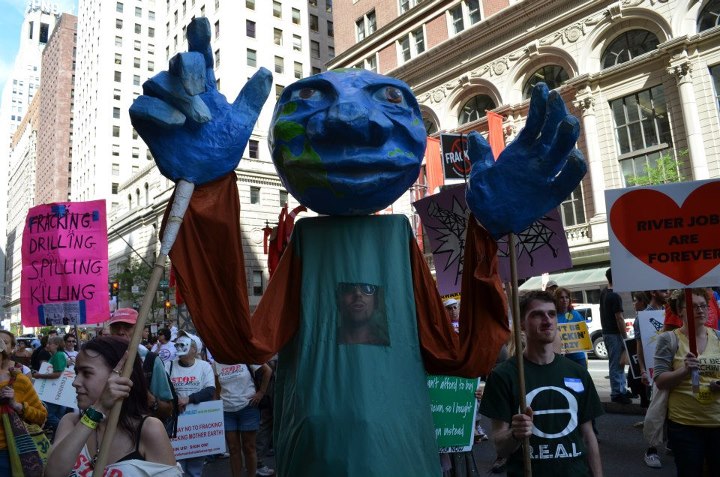
Gas industry conference attendees watched from the Convention Center windows while we rallied on Arch Street below. They’d been warned to remove their badges when leaving the building. It was very Ayn Rand. The speakers, the testimonies, the songs, the chants and street theatre were nothing short of spectacular. I suspect like many I am still processing it. And, yes, together we greeted them Philly-style…
For an amazing photo gallery of the event, visit the Shale Gas Outragefacebook page. My favorite image:
Meanwhile inside the industry conference, Shale Gas Insight, our governor, Tom Corbett, delivered an amped-up version of his usual anti-environment rhetoric. Pennsylvanians are being harmed by gas drilling, and by his administration’s weak environmental policies, though Corbett and the industry would like us ignore this fact. They say all energy production comes with “risks.” They need to say it the stricken farmer’s face, and to the grieving mother. Define “risks.”
For Immediate Release: September 21st, 2012:
“Shale Gas Outrage speakers, marchers push to stop fracking, support renewable energy, efficience, conservation”
Philadelphia, PA – “The nearest wellpad was 4000 feet from my house. After my family’s water became saturated with methane, officials told us not to use the kitchen stove because it could cause a flash fire… My granddaughter began vomiting, and only got better after they brought us a water buffalo [tank for clean water],” Tammy Manning, one of many speakers whose lives have been turned upside down by gas drilling, told the crowd of about 1000 at Shale Gas Outrage yesterday in Philadelphia. Rally and march participants vowed to protect people in affected communities by demanding a moratorium on shale gas drilling. Read the rest of this entry »
Protests against unconventional shale gas drilling have been popping up across the United Shale Shocked States of late, and the global List of Fracking Bans and Moratorium, curated by the incomparable Johnny Lineham at Fracking Hell (UK), has grown so long it speaks for itself. More citizens in more countries are demanding serious study of the impacts of unconventional gas production on human health and climate change. Is it a coincidence that the public’s interest in renewables has also been renewed? Given than many of the bans and moratorium are in the US, it’s safe to say most Americans expect an equally high level of environmental accountability from elected officials.
In front of the Convention Center, 13th & Arch Sts., Philadelphia, PA (19107)
Hyperbolic Hippies On The March?
Anti-Fracking Activists will go “toe-to-toe” with gas industry executives who will be present at The Marcellus Shale Coalition‘s second annual Shale Gas Insightconference, held on the very same day. As Protecting Our Waters, the Shale Gas Outrage host organization, states: “Industry will be rubbing elbows with some of our elected officials, their sights set on expanding toxic fracking throughout our region. Their ‘greenwashing’ doesn’t fool anyone: we’ve seen the damage, and even with a few new regulations, the damage is escalating out of control.” Read the rest of this entry »
This question was put to the Marcellus Shale Coalition’s Executive Vice President of Technical Affairs, Andrew Paterson, who was testifying on behalf of the 250-member gas industry trade group at a House Democratic Policy Committee hearing on Marcellus Shale Air Pollution at Delaware County Community College in Media, PA on October 12, 2011. Read the rest of this entry »
Please join me in supporting the Delaware Riverkeeper Network’s upcoming Virtual Canoe Race.
Adults and junior paddlers can join this fun race by “virtually” paddling down the scenic, historic Delaware. Or you can simply cheer on the racers by sponsoring a “virtual canoe.”
The Delaware River is the last major free flowing river in the Eastern U.S. Unlike most major river systems, the Delaware has no dams and so it can be canoed for its entire length. The Delaware Riverkeeper Network is committed to keeping the scenic, historic Delaware River Watershed free flowing, clean and healthy.
Each week, starting with a posting on September 30, a series of multiple choice questions and extra mileage opportunities will be posted to the Race Website. You will have one week to answer all of the questions correctly. The sooner you get in the questions the more river miles you earn. The more correct answers you have the farther down the River you will paddle!
Thanks for sharing my concern for our precious watershed environments, and for getting to know this amazing organization!
Jesse White [D-146th] isn’t afraid of the Pennsylvania GOP. Quite the contrary. He regularly wrangles with state republicans and Corbett’s DEP. According to a recent press release from his office, “White Legislation Would Make DEP Boss An Independently Elected Position,” he believes this key post ought to be on par with our state Attorney General, accountable to the highest possible authority. In a democracy, that’s the voters.
I was recently asked if there are actual instances of shale gas drilling contaminating water and air in Pennsylvania. The answer is a resounding, “Yes!”
Gas Industry pollution happens all the time. Here, there and everywhere. No matter how much the industry doesn’t want us to notice.
Many people have signed gas drilling leases and later come to regret it. Often, they are prevented from speaking out due to non-disclosure agreements stipulated by gas companies when compelled to award damages. Yet there are plenty of people who can – and do – tell their experiences with the gas industry. Hundreds, in fact, and there are even a few who are determined to keep a record. (Hint: It ain’t PA DEP.)
Bogus US Drilling Chemicals Database No Substitute For FRAC ACT
Make no mistake… the “Chemical Disclosure Registry” found at FracFocus.org is a sophisticated instrument of industry propaganda, not an independent, academic webtool. Though basically useless as a database, the site accomplishes more than simply informing the public about the chemicals a gas driller may, or may not, be using when hydraulically fracturing a well near you. FracFocus cleverly packages the information in an attempt to legitimize the use of the many dangerous toxins required in unconventional horizontal drilling. Read the rest of this entry »
Environmental incidents such as unconventional gas drilling accidents – or fraccidents – must be reported, wherever they occur. SkyTruthis a whiz-bang non-profit based in West Virginia. Their team uses remote sensing and digital mapping technologies to combine environmental protection with environmental awareness. Their motto: “As soon as WE know – YOU know.” Read the rest of this entry »
PA DEP’s Sharply Criticized, Incomplete Marcellus Production Report
A clean up effort is underway to address a serious data reporting error at The Department of Environmental Protection in Pennsylvania. The overburdened state agency has been cited several times for insufficient records-keeping, yet this latest DEP misinformation incident is proving difficult, if not impossible, to contain. As a result, reliable Marcellus production figures, eagerly sought by both those opposed to fracking as well as those seeking to profit from it, are in dangerously short supply. According to BloombergBusinessweek, Associated Press: Critics Say PA DEP Gas Data Has Serious Flaws.
In what appears to be the PA DEP equivalent of valve failure, the department recently released an incomplete Marcellus production report which, in turn, was derived from sloppy gas driller input. As a result, the official DEP report was missing key information from Chesapeake’s wells in Bradford County – the largest operator in the state’s most heavily drilled county.
Fracts Still Emerging
This isn’t the first time DEP screwed up on important Marcellus production data.
“New Report Raises Red Flag for Bats from Shale Gas Drilling”
Bristol, PA – The Delaware Riverkeeper Network released a new report authored by a bat expert at Bat Conservation International considering and documenting many potential impacts shale gas development and fracking can have on bat populations living in the Delaware River watershed. According to the report, the water withdrawals, water pollution, air pollution, and massive land disturbance associated with shale gas development pose serious threats for bat populations, including the little brown bat and the federally endangered Indiana bat. The report notes that bats have been significantly impacted by White-nose Syndrome and as a result are at increased risk from human impacts such as shale gas development. The location of the Marcellus shale, now the targeted shale formation for drilling across Pennsylvania, New York and elsewhere, overlaps some of the areas hardest hit by White-nose Syndrome. Read the rest of this entry »
Does The Corbett Administration Hate Nature As Much As They Hate Environmentalists?
Not all Pennsylvanians are prepared to accept the governor’s latest executive order for a fracking “Permit Decision Guarantee” without crying foul, as Kevin Begos of the Associated Press reports via Businessweek in Foes: Pa. State Permit Order Threatens Environment.
StateImpact’s Scott Detrow appears to concur that Corbett’s new decree is a potential political misstep in How Will Corbett’s Executive Order Change The Marcellus Permitting Process? on August 13, 2012. Though he barely hints at it, Detrow’s article earned him a proper bitch-slapping in the Comments section by the governor’s hyper-conservative energy czar, Patrick Henderson, who takes to task both StateImpact and the AP for their apparent and willful lack of “context.” Read the rest of this entry »
In the face of a frightful dearth of genuine environmental stewardship at top Pennsylvania state levels, New Yorkers living in Marcellus towns have been scrambling to proactively manage the imminent shale gas issues confronting them – from water management to truck traffic and emergency preparedness, to the negative impact on their taxbase. The Marcellus Effect chronicles the town of Caroline’s struggle to protect its water supply near Ithaca New York in How Far Is “Safe” When Protecting Aquifers?
Simultaneously, one of New York’s most picturesque finger lakes strives to maintain hard-won environmental gains as residents and fans organize to fight off an ill-advised gas storage facility planned for the abandoned salt mines located beneath it. You can learn about the citizen-led struggle to Save Seneca Lake in writer Elaine Mansfield’s moving video, Angry Faces, Placid Water: Fracking, LPG Gas Storage, and Seneca Lake produced by Owl Gorge Productions.
“The oil and gas industry plans to build an enormous liquid petroleum gas storage and distribution depot in abandoned salt mines under Seneca Lake near Watkins Glen, one of New York’s most popular scenic tourist attractions. Part of the Marcellus Shale hydrofracking nightmare, this huge facility threatens the pure water of Seneca Lake with petroleum gas and salt pollution, would burn off excess gas with a towering flare stack, produce air pollution, and be a visual and noisy blight along this gorgeous lake. Worst of all would be the constant risk of gas explosions. Local resident, writer, and activist Elaine Mansfield eloquently presents this issue in Smith Park along the shore of Seneca Lake.”
Truck traffic is a mundane yet no less horrendous byproduct of fracking. Imagine heavy tankers and Wide Loads roaring past your kitchen window every fifteen seconds, morning, noon, and night. Traumatic, right? Many compare it to an army mobilization. Track Traffic Procession — Longest One Yet, recorded in Montrose PA by veraduerga on July 29, 2012, gives you a pretty good idea of what drilling can do to an otherwise quiet town. The video was featured on the Bradford County-based blog Gas Wells Are Not Our Friends. In it, Vera sends a message to her neighbors in New York: “Keep it out.”
“Why do you have a camera?” asks a passerby.
“I’m recording it so people know what we’re going through. To tell the world, y’know, the nonsense that’s here…”
“Yeah, I don’t blame you.”
Deposit Truthland™ Nonsense Here
Vera also braved the truck traffic to attend a totally “truthy” screening of the gas industry infomercial Truthland in Deposit, NY. I’m pretty sure there’s nothing more obnoxious than arrogant gasholes bullshitting a shill-filled audience in a random auditorium, but you decide. Perhaps Energy In Depth has thought better of airing its propaganda on college campuses after the debacle at the State University of New York Buffalo earlier in July. Chip Northrup captured that scene brilliantly in Truthland Bombs In Buffalo, on No Fracking Way, a blog for New York and Pennsylvania hosted by ShaleShockMedia.org. Read the rest of this entry »
Online petitions aren’t ba-a-ad, but nothing’s more valuable than hard-copy signatures. Lots of `em. Because people who are willing to put their name to paper are also more likely to go out and vote. That’s why PennEnvironment has been busy spear-heading the largest anti-fracking petition in Pennsylvania.
“Powerful gas industry lobbyists and their allies in Harrisburg are pushing through policies that would expose our environment and communities to the dangers of Marcellus Shale gas drilling. But they’ve got a fight on their hands — thousands of Pennsylvanians are joining our call to help stop gas drilling from contaminating our drinking water, polluting our air, destroying our forests and threatening our health.”
Already more than 50, 000 petitioners are calling on legislators “to support a moratorium on further shale gas extraction in Pennsylvania until it is proven safe for our environment and the public’s health.” The current goal is reach 100,000 so ask all your friends to sign it, too!
On May 6, 2012, a deer drank from a pool of water above an abandoned gas well in the Allegheny National Forrest. Deer drinking from a puddle, that’s nothing new. All I know is, I would never want my little doe drinking that poison!
A Leaking Gas Well In The Allegheny National Forest
Saveourstreamspa.org uploaded this short, eye-opening video: “The Allegheny National Forest is plagued with abandoned, wells that have been left behind, unplugged by oil and gas operators. Not only are many of these wells spewing methane into the atmosphere, but fluids are being released from these wells and are being consumed by game and wildlife.” Read the rest of this entry »
“Last year, two thousand people flooded the streets of Philadelphia to confront the mega-corporations that are playing fast and loose with public health. Protect our communities and stand up for justice! Protect air, water, farms and food. Fight against climate change by fighting unconventional dirty drilling. Make sure our voices are even louder this year, and more clear: No Fracking. No Cracking. Send this industry packing! Don’t let them frack our future!”
Get the very latest on events, speakers and educational sessions at shalegasoutrage.org. Want to volunteer? Please contact this amazing grassroots organization at protectingourwaters@gmail.com.
I’ve been curious why the lamestream media has been slow to cover the Stop The Frack Attack! rally on Saturday in DC. After all, there were several thousand protesters. (I was there, I counted them.) Then I was reminded that no major news network, not even CNN, covered the largest public protest in Japan’s history earlier in the month, either – 100,000 people opposed to more nuclear power for that Fukushima-shocked nation. Similarly, the media ignored ensuing protests in Tokyo, though the story was finally picked up by Reuters and The Washington Post after protesters vitalized a key gubernatorial election there. Has ANGA threatened to pull their eight billion ads? Philip Bump examines the troubling phenomena of an under-performing media willfully ignoring the news in A Weekend Of Protests Barely Makes The Papers on Grist.org. Read the rest of this entry »
I may have been the 5000th protester, but I got to shake Josh Fox’s hand and thank him for keeping our tap water safe! For every person who made it to the Stop The Frack Attack! rally in Washington DC, many more were there in spirit. This movement is growing!


 Keep Tap Water Safe